Testing Didn’t Break. It Just Stopped Keeping Up
For years, test automation followed a predictable pattern.
You wrote scripts. You defined selectors. You maintained them. And every time the UI changed, you went back and fixed what broke.
This cycle was accepted as part of the job.
Not ideal, but expected.
Then applications started evolving faster. Interfaces became dynamic. Releases became continuous. And suddenly, the cost of maintaining tests began to rival the cost of building features.
That’s when teams started asking a different question.
Not “how do we write better test scripts?”
But “why are we still writing so many scripts in the first place?”
This is where the combination of AI-powered test automation and Playwright MCP (Model Context Protocol) begins to shift the conversation.
Because it replaces scripting with something more natural.
Intent.
What Playwright MCP Actually Changes in Testing
To understand the shift, you need to understand the limitation of traditional automation.
Most tools interact with applications indirectly.
They rely on:
- CSS selectors
- XPath queries
- DOM structure assumptions
These are fragile.
Even small UI changes can break tests.
Playwright improved this with better selectors and stability.
But MCP takes it further.
It changes how the automation tool sees the application.
Instead of guessing based on structure, MCP allows AI to access the accessibility tree, which represents the actual meaning of elements.
This means:
- A button is recognized as a button
- A form field is recognized as input
- A link is understood as navigation
This removes ambiguity.
And that changes everything.
From Code to Conversation: The Rise of Natural Language Testing
One of the most noticeable changes with Playwright AI test automation is how tests are created.
Instead of writing code like:
await page.click(‘#login-btn’);
You describe the action:
“Open the login page and sign in with valid credentials”
The system interprets this instruction and translates it into executable steps.
This is not just convenience.
It changes who can participate in testing.
Product managers, QA analysts, and even non-technical stakeholders can now define test scenarios.
This expands testing beyond developers.
And improves coverage.
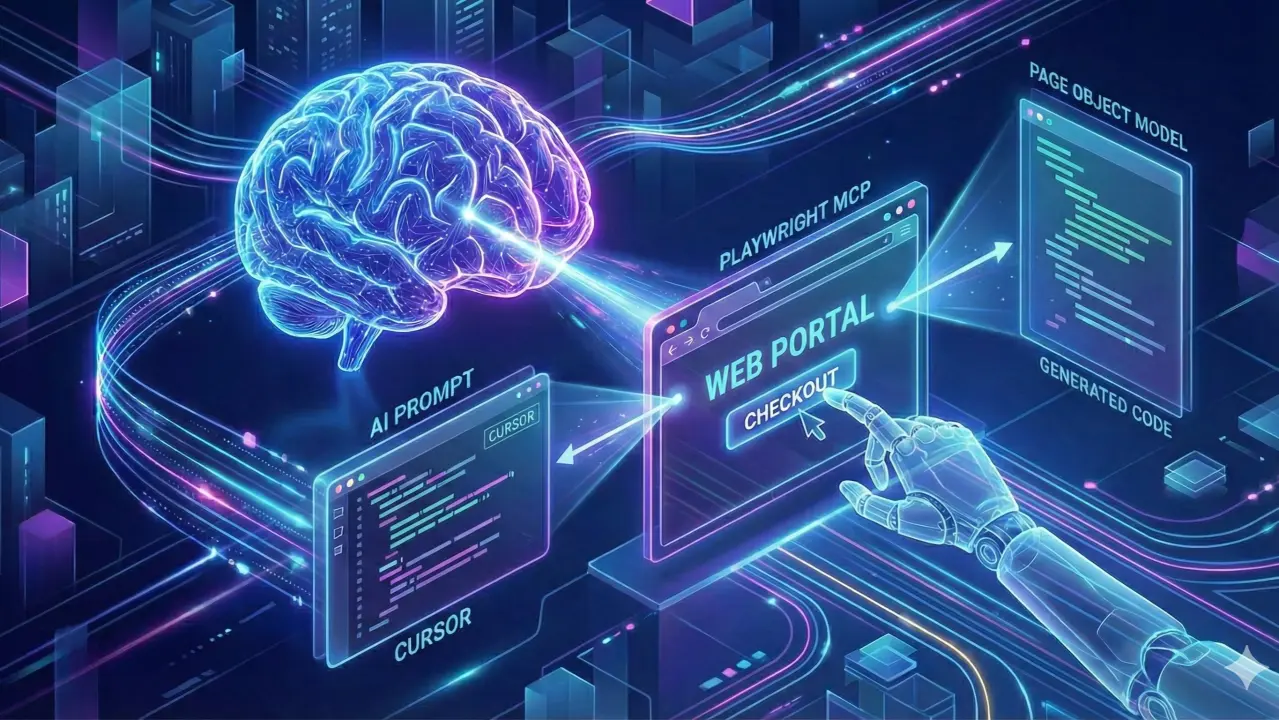
How AI and Playwright MCP Work Together in Practice
The interaction between AI and Playwright MCP is not random.
It follows a structured flow.
- The user provides an instruction in natural language
- The AI interprets the intent
- MCP exposes the browser context
- Playwright executes actions with precision
Think of it as a collaboration.
AI decides what needs to happen.
Playwright ensures it happens correctly.
This combination creates a system that is both flexible and reliable.
Why Traditional Automation Feels Slower Over Time
At the beginning of a project, automation feels fast.
You write tests quickly. Everything passes. The system works.
But as the application grows:
- Tests increase
- Maintenance increases
- Debugging becomes slower
Eventually, teams spend more time fixing tests than writing new ones.
This is where traditional automation reaches its limit.
Because it depends on static assumptions.
And modern applications are not static.
Self-Healing Tests: Not a Buzzword, but a Real Shift
One of the most practical advantages of AI-driven test automation is self-healing.
When the UI changes, the AI does not rely on fixed selectors.
It understands intent.
So if a button moves or its structure changes, the system can still find it.
This reduces:
- Test failures
- Maintenance effort
- Debugging time
And more importantly, it keeps tests relevant.
Smarter Testing Beyond the Happy Path
Most automated tests focus on expected behavior.
Click this. Submit that. Verify output.
But real users do not follow scripts.
They make mistakes. They explore. They behave unpredictably.
AI introduces a different capability.
It can:
- Suggest additional test paths
- Explore edge cases
- Identify unusual flows
This leads to deeper testing.
Not just validation, but exploration.
Integrating Playwright MCP into Real Development Workflows
Adopting Playwright MCP does not require a complete overhaul.
It integrates into existing tools.
For example, in a typical setup using Visual Studio Code:
- Install Playwright
- Add MCP server support
- Connect with AI assistants like GitHub Copilot
Once configured, you can start generating tests directly from prompts.
This fits naturally into modern development workflows.
Especially in teams already using CI/CD pipelines.
CI/CD and AI Testing: Where Speed Meets Stability
One concern teams often have is integration.
Will this work with existing pipelines?
The answer is yes.
Playwright MCP works with:
- GitHub Actions
- Jenkins
- GitLab CI
Tests can be generated, executed, and validated as part of the pipeline.
This means:
- Faster releases
- Reduced manual effort
- Continuous validation
Why Human Oversight Still Matters
Despite all the advantages, AI does not replace human testers.
It changes their role.
Instead of writing every test manually, testers focus on:
- Validating test logic
- Ensuring meaningful coverage
- Refining test architecture
AI generates speed.
Humans provide judgment.
This balance is critical.
Because automation without understanding can lead to false confidence.
The Architecture Side: Keeping Tests Maintainable
Even with AI, structure matters.
Generated tests should follow best practices like:
- Page Object Model
- Modular design
- Clear naming conventions
Without this, test suites can become messy over time.
AI helps create tests.
But teams must maintain discipline in how they organize them.
Challenges You Should Expect
No technology shift comes without challenges.
With Playwright MCP, teams may face:
- Learning curve in prompt design
- Need for validation of AI-generated tests
- Dependency on evolving standards
These are manageable.
But they require awareness.
Where This Fits in Modern Software Development
Testing is no longer a separate phase.
It is part of the development cycle.
With AI and Playwright MCP:
- Testing becomes faster
- Feedback loops shorten
- Quality improves earlier
This aligns with modern practices like:
- Shift-left testing
- Continuous delivery
- DevOps integration
Why Businesses Are Moving Toward Intelligent Automation
The shift is not just technical.
It is strategic.
Businesses want:
- Faster releases
- Lower maintenance costs
- Higher reliability
AI-powered testing helps achieve this.
Because it reduces friction.
How Rushkar Technology Helps Teams Transition
Adopting AI-driven testing requires more than tools.
It requires experience.
Rushkar Technology works with teams to:
- Implement intelligent automation frameworks
- Integrate Playwright with modern workflows
- Reduce testing overhead
- Improve release cycles
With 15+ years of experience and 180+ projects delivered, the focus is on practical execution.
From custom software development services to hire dedicated developers, the goal is to build systems that scale without increasing complexity.
The Bigger Picture: Testing Becomes Adaptive
What we are seeing is not just better tools.
It is a shift in how testing works.
From:
- Static scripts
To:
- Adaptive systems
From:
- Manual effort
To:
- Intent-driven automation
And this will define the next phase of QA.
Conclusion: The Shift from Effort to Intelligence
Testing is no longer about how many scripts you can write.
It is about how effectively you can validate behavior.
Playwright MCP and AI bring testing closer to how humans think.
Describe what you want.
Let the system figure out how to do it.
And refine it with experience.
This is not the end of testing.
It is the evolution of it.
FAQ
1. What is Playwright MCP in simple terms?
It allows AI to understand and interact with web applications using real context instead of guessing through selectors.
2. Can non-developers use AI test automation?
Yes. Natural language inputs make it accessible to broader teams.
3. Does this replace traditional testing completely?
No. It enhances it and reduces manual effort.
4. Is Playwright MCP production-ready?
It is evolving but already useful for modern testing workflows.
5. Why choose Rushkar Technology for automation?
Because of proven expertise in scalable, AI-driven development and testing solutions.