If you step back and look at any country long enough, you’ll notice something subtle but powerful. People don’t just live inside systems. They live inside stories. Stories about who they are, where they came from, what they value, and what they stand for. These stories are not random. They are shaped, repeated, and reinforced over time.
This is where political narratives shape national identity, becoming more than an abstract idea. It becomes a mechanism. Nations are not only defined by borders or institutions. They are defined by the narratives that people collectively believe and repeat, often without questioning where those narratives came from.
And once those narratives settle in, they influence everything. Policy decisions, public behavior, cultural priorities, and even how a country sees itself in relation to others.
Narratives Simplify Complex Reality
Modern societies are complex. Economies are layered, cultures are diverse, and histories are long and often contradictory. But people don’t process complexity easily at scale. They rely on simplified versions of reality. Narratives provide that simplification.
This is a key part of the role of political narratives in society. They take complex historical and social realities and translate them into understandable frameworks. These frameworks don’t always capture every detail, but they create coherence. They give people a shared understanding, even if that understanding is partial.
Over time, repetition turns these simplified versions into accepted truth. Not necessarily factual truth, but functional truth. Something people operate on.
Identity Is Built Through Repetition
A narrative does not become powerful the moment it is introduced. It becomes powerful when it is repeated. Across speeches, media, education systems, public discussions, and cultural expressions. The more a narrative is repeated, the more familiar it becomes. And familiarity creates acceptance.
This is how national identity formation politics works in practice. Identity is not fixed. It is reinforced continuously. Each repetition strengthens the connection between the narrative and the collective identity.
People begin to see themselves through that lens. Not because they were forced to, but because it becomes the default way of understanding their place in society.
Media Amplifies and Shapes Narratives
The media plays a central role in how narratives spread. It does not just report events. It frames them. The way information is presented influences how it is understood. Over time, consistent framing builds a narrative structure that people begin to recognize.
This is where media influence on national identity becomes significant. The media does not create identity on its own, but it reinforces the narratives that contribute to it. It decides what gets attention, what is emphasized, and what is repeated.
In a digital environment, this process accelerates. Narratives can spread faster, reach wider audiences, and evolve more quickly. But the underlying mechanism remains the same.
Selection, framing, repetition.
Narratives Define “Us” and “Them”
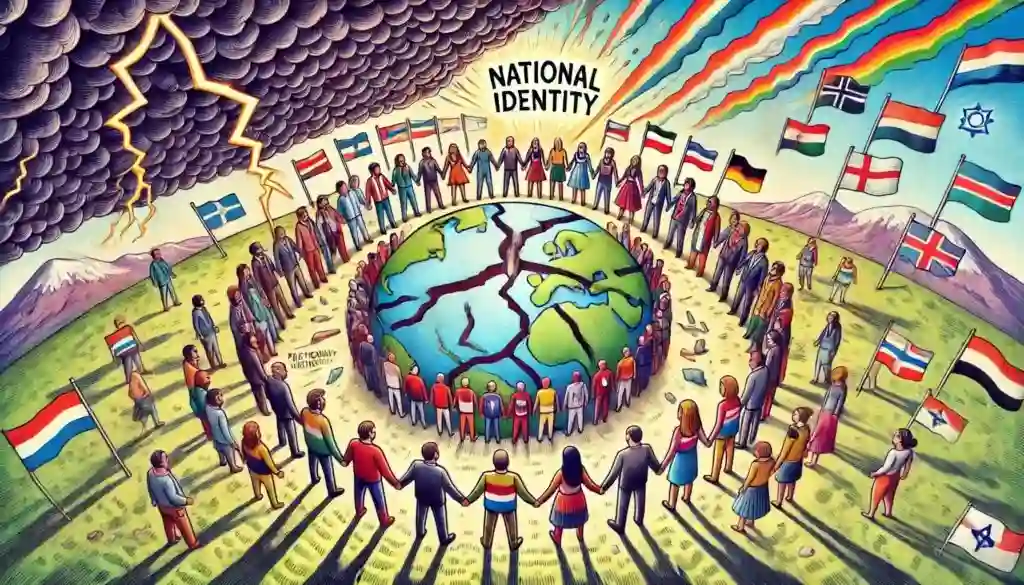
One of the most powerful aspects of political narratives is how they define belonging. They create a sense of “us,” a shared identity that connects individuals within a nation. At the same time, they often define “them”, those outside the group.
This dynamic is central to the impact of political storytelling on culture. It shapes how people relate to others, both within and outside their society. It influences attitudes toward diversity, cooperation, and conflict.
These boundaries are not always rigid, but they are influential. They guide perception, often without people being fully aware of it.
History Is Interpreted, Not Just Remembered
Historical events are not just recorded. They are interpreted. The same event can be framed in different ways depending on the narrative being constructed. Over time, certain interpretations become dominant.
This is part of how governments shape public perception. By emphasizing specific aspects of history, institutions contribute to the narratives that define identity. Education systems, public commemorations, and official statements all play a role.
This does not mean history is fabricated. It means it is presented selectively.
And selection shapes perception.
Narratives Influence Policy Direction
Political narratives are not just cultural tools. They influence policy. If a nation sees itself in a particular way, that perception affects decision-making. Policies are often aligned with the narrative that defines the country’s identity.
This creates a connection between political narratives and public opinion. Public support for policies is influenced by how those policies align with the dominant narrative. If a policy fits the story people believe about themselves, it is easier to accept.
If it doesn’t, resistance increases.
Narratives Can Evolve, But Slowly
National identity is not static, but it does not change quickly. Narratives that have been reinforced over long periods become deeply embedded. Changing them requires consistent effort and time.
This is why shifts in identity often follow major events. Economic changes, social movements, or external pressures can create conditions where new narratives emerge. But even then, change is gradual.
Old narratives don’t disappear immediately.
They coexist with new ones for a time.
Where Narratives Gain Their Strength
If you break it down, political narratives gain influence through a few consistent channels:
- repetition across institutions and media
- alignment with cultural values and experiences
- reinforcement through education and public discourse
- emotional connection with collective identity
These elements work together. Remove one, and the narrative weakens. Strengthen them, and the narrative becomes more stable.
The Risk of Over-Simplification
While narratives provide clarity, they also simplify. That simplification can become a limitation. Complex realities may be reduced to single explanations. Nuance may be lost. This can lead to misunderstandings or rigid thinking.
This is one of the challenges in the role of political narratives in society. They are useful, but they are not complete. Relying on them too heavily can reduce flexibility in how societies adapt to new situations.
The Digital Layer Changes the Speed
Digital platforms have changed how narratives spread. Information moves faster. More voices contribute. Narratives can be challenged and reshaped in real time.
This adds complexity to media influence on national identity. Traditional media no longer controls the narrative alone. Individuals, communities, and independent creators all participate.
This creates a more dynamic environment.
But it also makes narratives less stable.
The Future of National Identity
National identity will continue to evolve as societies change. New narratives will emerge. Old ones will adapt or fade. The process will remain influenced by politics, media, and culture.
The key difference is speed.
Changes that once took decades may now happen faster. But the underlying mechanism, repetition, reinforcement, and alignment, will remain the same.
Final Thought
A nation is not just defined by its borders.
It is defined by the stories it tells about itself.
Those stories shape perception, influence behaviour, and guide decisions in ways that are often invisible but deeply impactful. Understanding how political narratives shape national identity is not about questioning identity itself.
It is about recognizing how that identity is formed.
Because once you see the structure behind the story, you start to understand why people believe what they believe.
And why changing those beliefs is never as simple as presenting new information.